Apr 2, 2019
Gambling harm doesn’t happen in isolation – it intersects with substance use, mental health, and everyday life.
At Lives Lived Well, we see the impact of gambling harm every day in our Alcohol and Other Drugs (AOD) services. Many of our clients don’t seek help for gambling, even when it’s causing significant distress. In fact, gambling often remains in the background – unspoken, unrecognised, and untreated (Hing et al., 2015). Yet, when we look at the bigger picture, the connection between gambling and substance use is undeniable (Yarbakhsh et al., 2023).
Our recent data shows that more than half of our AOD clients gamble, and within that group, nearly 1 in 3 are experiencing high-risk gambling. The overlap is even greater for certain substances: high-risk gambling is over four times more likely when methamphetamine use is present compared to alcohol use, and over than three times more likely compared to cannabis use. Additionally, we see that as gambling severity increases, so does depression and anxiety. These patterns highlight why gambling harm can’t be treated as an isolated issue, it needs to be considered alongside substance use and mental health.
Why Gambling Harm Often Goes Unnoticed in AOD Treatment
When we think about gambling harm, we are often guided by statistics from the general population. However, most people in the general population will never require treatment for gambling-related issues, with 0.67% of Queensland adults estimated to experience high-risk gambling (Department of Justice and Attorney-General, 2024). In AOD treatment settings, we see a very different picture – one where gambling harm is more concentrated and where the usual risk patterns shift. This means we must challenge common assumptions about who is at risk and ensure that our interventions are based on real-world data from those actually seeking support.
By embedding standardised screening, we remove subjectivity and prevent outdated stereotypes from influencing who gets help. Gambling harm doesn’t fit a single profile – it affects people of all ages, genders, and backgrounds. AOD treatment presents a critical opportunity to engage people who are experiencing gambling harm but may never seek gambling-specific support. Many clients feel comfortable discussing their substance use but hesitate to talk about gambling due to stigma, shame, or simply not viewing it as an issue. Through systematic screening and proactive intervention, we help clients recognise and address gambling harm earlier, preventing crisis situations and supporting long-term recovery.
Putting This Into Perspective
Based on recent population data and gambling help-seeking rates, an estimated 4,458 people in Queensland with gambling problems accessed gambling counselling services in the past year (Australia Bureau of Statistics, 2021; Department of Justice and Attorney-General, 2024). However, within Queensland AOD treatment services alone, approximately 7,630 clients may have co-occurring gambling problems, yet many of them may not be receiving gambling-specific support (Australian Institute of Health and Welfare, 2024; Cowlishaw, 2014).*
*Please note that these numbers are based on available data and estimations, and actual figures may vary depending on various factors, including help-seeking behaviours and service access trends.
This highlights a significant gap between need and service access, reinforcing the importance of integrating gambling screening and intervention within AOD services to ensure clients receive comprehensive care. By taking a proactive, integrated, and harm reduction-focused approach, we can ensure that gambling harm is addressed within AOD treatment, helping more people access support before they reach crisis point.
Lives Lived Well’s Gambling Intervention team is available to present free workshops which focus on identification of gambling harm and brief interventions. This is available in workplaces across Queensland and can be tailored to your service. For enquiries please call 1300 727 957 to speak with the program coordinator, Georgia Dellosa or email georgia.dellosa@liveslivedwell.org.au.
To complete our free online Gambling Screening training, register here.
References
Australia Bureau of Statistics. (2021). 2021 Queensland, Census All persons QuickStats | Australian Bureau of Statistics. https://www.abs.gov.au/census/find-census-data/quickstats/2021/3
Australian Institute of Health and Welfare. (2024). Alcohol and other drug treatment services in Australia annual report, Data. https://www.aihw.gov.au/reports/alcohol-other-drug-treatment-services/alcohol-other-drug-treatment-services-australia/data
Cowlishaw, S. (2014). Comorbid problem gambling in substance users seeking treatment. Victorian Responsible Gambling Foundation.
Department of Justice and Attorney-General. (2024). Queensland Gambling Survey 2023: Final Report. Queensland Government. https://www.publications.qld.gov.au/ckan-publications-attachments-prod/resources/50ba6699-7699-483b-bc27-ee737698a667/queensland-gambling-survey-2023-final-report.pdf?ETag=d597678c1f1a0d325a1a3b6dc6eca6d9
Hing, N., Russell, A., Nuske, E., & Gainsbury, S. (2015). The stigma of problem gambling: Causes, characteristics and consequences. Victorian Responsible Gambling Foundation. https://responsiblegambling.vic.gov.au/documents/351/Hing-Stigma-of-problem-gambling-2015.pdf
Yarbakhsh, E., van der Sterren, A., & Bowles, D. (2023). Screening and Treatment for Co-occurring Gambling and Substance Use: A Scoping Review. Journal of Gambling Studies, 39(4), 1699–1721. https://doi.org/10.1007/s10899-023-10240-z
Jan 31, 2019
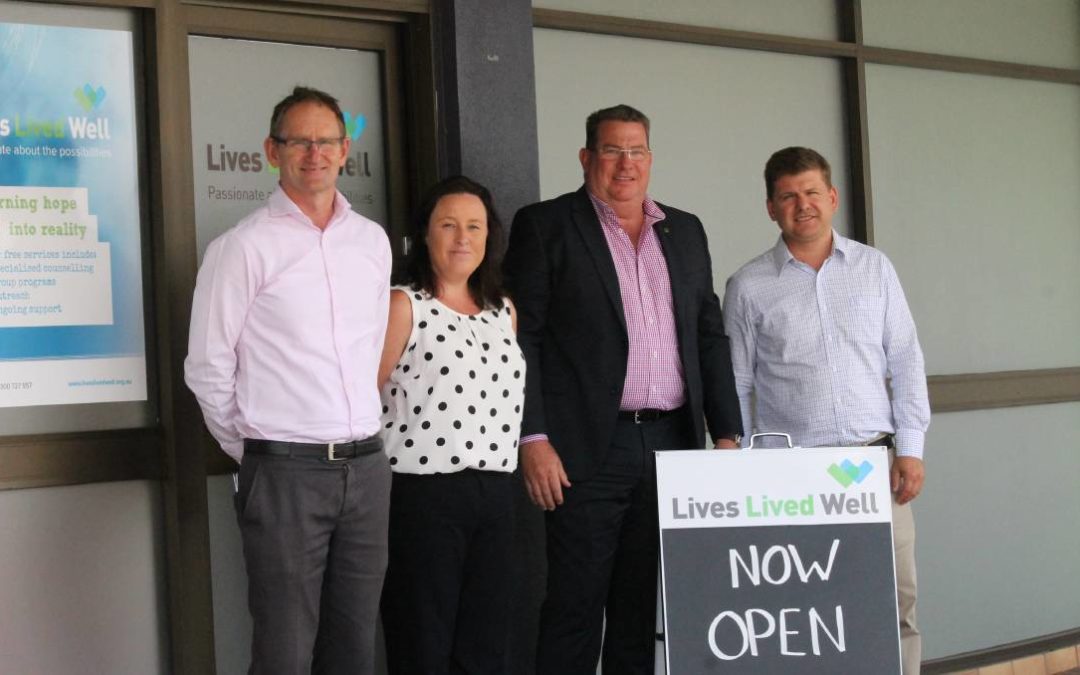
LLW CEO Mitchell Giles, Team Leader Ronelle Waring, Scott Buchholz MP and Jon Krause MP
Lives Lived Well’s official opening of a new space in Beaudesert will allow for an increase in drug and alcohol support to the community, including the running of group programs.
Moving into a new and larger space, the Lives Lived Well team will be able to increase their counselling support in the area and be able to offer group work through the Smart Recovery program as well as family information sessions through the Breakthrough for Family program.
Lives Lived Well CEO Mitchell Giles said the new space would allow for more support for both individuals and families in the Beaudesert community. “In 2018, we supported about 80 people, with our team operating out of Illoura Carinity Care,” he said. “Opening our own space means we can be available more often and, with more space, can run groups and information sessions, increasing the number of people we can support.”
Mr Giles said: “Lives Lived Well is able to offer these free supports in Beaudesert thanks to the support of the Brisbane South PHN through the Australian Government’s PHN program and the Queensland Government, for which we are very grateful.”
Speaking at the opening, Federal Member for Wright, Scott Buchholz MP said Lives Lived Well provided essential community support for those impacted by drugs, alcohol and mental health issues. “Lives Lived Well provides a respected and essential service for our community here in Beaudesert and across the Scenic Rim,” Mr Buchholz said.
“The opening of their new office today shows their value to our local community and the importance of work they do in getting lives back on track following the impact of drugs, alcohol and mental health.”
Also welcoming the launch, Jon Krause, State Member for Scenic Rim, said that the Lives Lived Well team would help cover a missing link in social services for the Beaudesert district by providing much needed support for the wellbeing of those whose lives have been affected by substance use.
“The Scenic Rim Electorate needs its fair share of services and the opening of a new, larger space for Lives Lived Well shows the need and support that networks like this have in our community,” Mr Krause said.
Lucille Chalmers, Brisbane South PHN’s General Manager of Commissioned Programs, said evidence shows access to specialist alcohol and drug (AOD) treatment plus improved coordination of care and increased early intervention delivers positive impacts not only for the individual, but for the community and the broader health system.
“Brisbane South PHN recognises the challenges faced by individuals experiencing harm from problematic substance use, and the people who support them. Beaudesert is one of our priority locations, as identified in our 2018 Needs Assessment, so we are very pleased to be able to support extending services in the region,” she said.
For media inquiries, email Lives Lived Well Marketing and Communications Team Leader, Michelle Saftich on michelle.saftich@llw.org.au
Dec 17, 2018
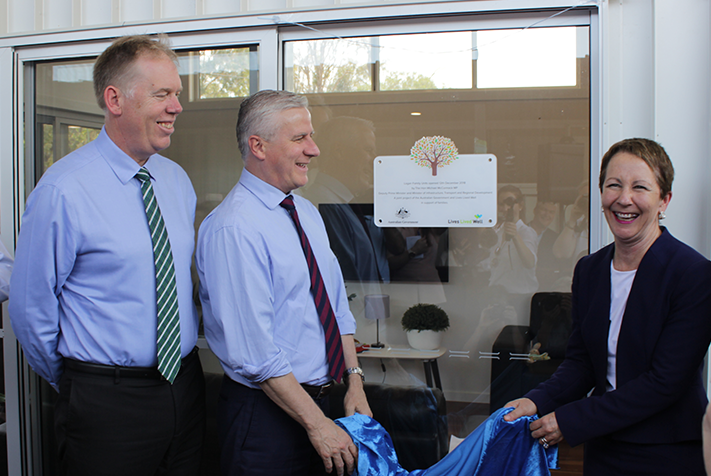
Unveiling the plaque: Deputy Prime Minister and Minister for Infrastructure, Transport and Regional Development, the Hon Michael McCormack, with Federal Member for Forde, Bert van Manen (left) and the Hon Di Farmer, State Minister for Child Safety, Youth and Women and Minister for the Prevention of Family and Domestic Violence.
Queensland families will have access to a unique drug and alcohol support service starting in the new year, following the official launch of our Family Recovery Units at Logan House on 12 December.
The program makes it possible for parents to receive support, while their young children stay with them on site in the two and three-bedroom units.
Parents can access wrap-around support on site at Logan including specialist alcohol and drug counselling and information, group sessions and parenting, life and health support, whilst having appropriate care arrangements set in place for their children.
The opening was jointly conducted by the Hon Michael McCormack, Deputy Prime Minister and Minister for Infrastructure, Transport and Regional Development, the Hon Di Farmer, State Minister for Child Safety, Youth and Women and Minister for the Prevention of Family and Domestic Violence; along with Lives Lived Well Chair Damian Wright. The Federal Member for Forde, Bert van Manen and the Acting Logan Mayor, Cherie Dalley also attended.
The Australian Government invested $986,000 in the construction of the units, jointly funding it with Lives Lived Well, which contributed more than $1M. The Queensland Government has committed to providing $1.7M in funding over three years to support the operation of the family alcohol and drug recovery program at the units.
Speaking at the launch, Mr McCormack said he knew Logan House, set among gum trees in Logan’s rural southwest, would be a special place.
“People will look along this deck at this beautiful view and will see there is hope, there is a future. They will experience the warmth of the counsellors here, people who will share their expertise, their care, their compassion, their love and it will make a difference.”
Lives Lived Well Chair Damian Wright expressed gratitude for the funding support of both state and federal governments.
“This funding allows us to work closely with families to turn their lives around after the harms and disruption of alcohol and drugs,” Mr Wright said.
Dec 17, 2018

Our ICE Help service in Mackay in north Queensland is hosting a family support group for Aboriginal and Torres Strait Islander families affected by methamphetamine use.
The service provides counselling and other supports to family members – regardless of whether the person with the ice dependency is accessing our support. Offering support to families has proven to be a powerful early intervention strategy for our ICE Help service.
Lives Lived Well’s ICE Help service came into effect in April 2017, enabled by funding from the Northern Queensland PHN. From 1 April 2017 to 1 November this year, the service supported 305 clients – made up of a mix of people seeking help for problematic ice use, as well as their families.
Sixty-four per cent of the people seeking help for their own use of methamphetamine were male, while 55 per cent of people seeking help for a family member were female. The most common age range of clients and family members was 18 to 45 years.
Many of the people accessing ICE Help go on to engage with other Lives Lived Well services in Mackay, including psychosocial supports, day withdrawal and outreach. More information about our Mackay services here.
 1300 727 957